The most useful products around Big 5 Global will not necessarily be the newest or most visually impressive. For clients planning a fit-out or renovation in the UAE, the real questions are whether a product is suitable, available, properly supported and
realistic for the project budget and programme.
Our watchlist therefore focuses on practical fit-out decisions: products that can solve a genuine project problem, procurement commitments that can be verified and materials that suitable contractors can install and maintain.
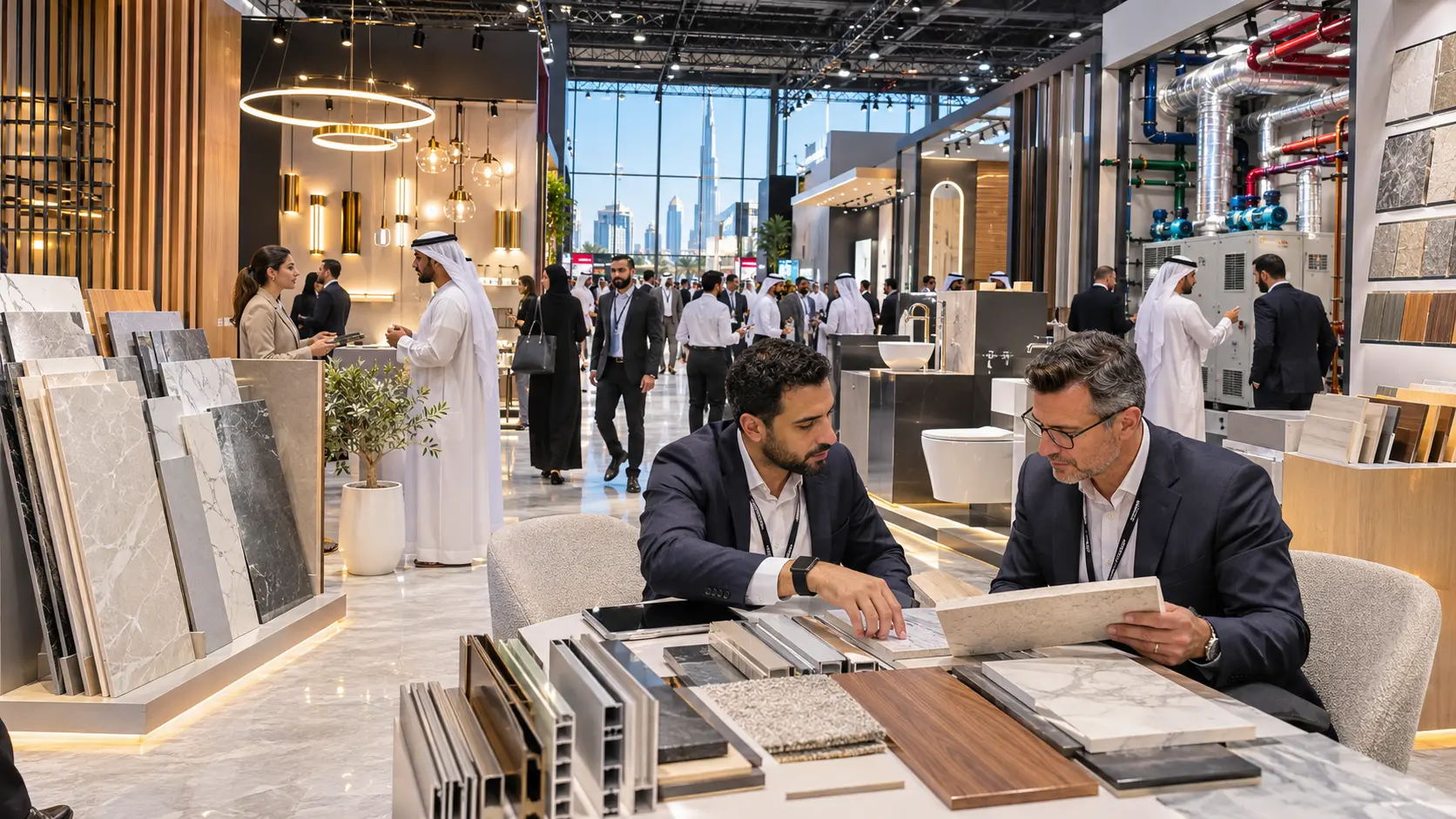
Big 5 Global 2026 runs from 23 to 26 November at Dubai World Trade Centre, alongside seven co-located events including HVACR World and Marble & Stone World. The organiser’s themes this year include supply chain resilience, and the Big 5 Talks programme adds a Building Codes & Regulation stream on 24 November. It is a trade-only event, and visitors under 21 are not admitted.
Products with clear availability and lead times
A strong product demonstration is only the starting point. Before specifying any material, fixture or
system, project teams need to understand:
- Whether it is stocked in the UAE or imported to order
- Its current lead time
- How long the quoted price remains valid
- Whether samples and technical data are available
- What happens if the specified product becomes unavailable
- Whether there is a suitable locally available alternative
- Who provides installation, commissioning and after-sales support
These questions matter because imported product categories face different pressures from materials with stronger domestic supply.
Imported building-material costs above pre-conflict levels, according to UAE developers.
Moody’s Ratings analysis, reported by Khaleej Times
According to Moody’s Ratings analysis reported by Khaleej Times, UAE developers said imported building-material costs were around 20–25% above pre-conflict levels. The categories identified as more exposed included lifts, air-conditioning equipment, MEP components, lighting, wood joinery, natural stone and furnishings.
MEP and air-conditioning equipment that suits the project
Mechanical, electrical and plumbing systems are not always the most visible part of a completed interior, but they can shape cost, coordination and programme. With HVACR World running alongside the main show, there will be plenty to see.
When reviewing air-conditioning, lighting, controls and other MEP products, useful questions include:
- Is the equipment appropriate for the building’s existing infrastructure?
- What design information is required before it can be specified?
- Does it require specialist installation or commissioning?
- Are replacement components available in the UAE?
- Who provides technical and warranty support?
- What is the expected procurement lead time?
- Are there approved alternatives if availability changes?
No product should be selected solely because it performs well in isolation. It must work with the base building, design, authority requirements and wider construction sequence.
This is where early coordination between designers, suppliers and contractors becomes important. Clients exploring a commercial or residential project can review the scope covered by interior fit-out and renovation services before preparing their brief.
Lighting that balances design with buildability
Lighting can influence how a space looks and functions, but the fitting itself is only one part of the decision.
We will be looking for lighting products supported by:
- Clear technical documentation
- Realistic delivery commitments
- Compatible control systems
- Accessible replacement components
- Suitable colour temperature and output options
- Installation requirements that can be coordinated early
- Reliable local technical support
Bespoke fittings may help create a distinctive result, but clients should understand the effect on lead times, replacement options and future maintenance. A product that is difficult to source again may create an avoidable operational problem later.
Joinery, stone and finishes with practical alternatives
Wood joinery, natural stone, furnishings and specialist finishes can have a major visual impact. They are also among the import-dependent categories identified in the Moody’s reporting, and Marble & Stone World will put a wide range of stone in front of visitors.
When a product relies on imported materials, project teams should ask suppliers to distinguish between:
- Stocked products and made-to-order products
- Standard and bespoke sizes
- Confirmed and indicative lead times
- Natural variation and product defects
- Material-only and installed prices
- Approved substitutions and lookalike alternatives
- Local fabrication and overseas fabrication
A substitution should not be treated as an automatic downgrade. In some cases, an alternative product may offer a similar design result with a more manageable supply route. The important point is to assess performance, appearance, compliance, availability and cost together rather than making a last-minute decision when the original specification cannot be obtained.
Supplier commitments that can survive the tender stage
An exhibition conversation is not a procurement agreement. Any indicative price or lead time should be checked again when the project scope, quantities, specifications and delivery programme are known.
How long prices for some materials, including steel, may now be held as UAE contractors shorten price guarantees.
Currie & Brown, reported by TradeArabia and Zawya
Currie & Brown’s UAE market overview, as reported by TradeArabia and Zawya, said contractors were becoming less willing to hold fixed prices for long periods. The reporting described shorter price guarantees, more tender conditions and greater use of fluctuation clauses. It also noted that prices for some materials, including steel, may now be held for only around 30 days.
That makes several tender questions particularly important:
- How long is the quotation valid?
- Which costs are fixed and which may fluctuate?
- Are delivery, installation and commissioning included?
- What assumptions or exclusions apply?
- Is the specified product secured or merely proposed?
- Is advance purchasing possible?
- Who carries the risk if prices or lead times change?
- What documentation is required to place an order?
Clients should not assume that a price discussed at an event will remain available when their project reaches procurement.
Products that contractors can actually deliver
Finding an interesting material is not the same as having a workable project solution. Installation quality, sequencing, technical capability and experience with the relevant project type all matter.
Contractors Direct connects clients with pre-vetted contractors for residential and commercial fit-out and renovation projects in the UAE. Confirmed checks include trade licensing, insurance, relevant experience, past projects, client references, financial standing, team capability, health and safety, and reviews of live and completed work.
Clients can read more about how contractor vetting works and the platform’s quality standard. Vetting can reduce some of the uncertainty involved in finding a contractor independently, but it does not guarantee a particular outcome, price or timeline.
When bringing a product idea into a project brief, it helps to include:
- Product name and supplier
- Technical data sheets
- Samples or finish references
- Indicative price and quote date
- Stated lead time
- Installation requirements
- Warranty information
- Acceptable alternatives
- Photographs showing the intended application
This gives prospective contractors more useful information when assessing scope, buildability and procurement requirements.
A practical event-floor checklist
Before spending time on a product demonstration, ask:
SUITABILITY
- What project types is the product designed for?
- Are there limitations on where it can be installed?
- What preparation or supporting work does it require?
SUPPLY
- Is it stocked in the UAE?
- What is the current lead time?
- Can availability be confirmed in writing?
- What alternatives are available?
COST
- How long is the price valid?
- What is excluded?
- Does the price change with quantity, finish or delivery location?
INSTALLATION
- Does it require an approved installer?
- Is training or specialist equipment needed?
- Who commissions or signs off the installation?
SUPPORT
- Is technical support available locally?
- How are defects, replacements and warranty issues handled?
- Are spare parts readily available?
From product discovery to project decision
The best outcome from an industry event is not a long list of fashionable products. It is a shorter list of credible options supported by technical information, realistic procurement details and a clear reason for inclusion in the project.
Clients should avoid committing to products before confirming their complete scope, compatibility, installation requirements and budget implications. Where several products affect one another, they should be reviewed as part of the overall design and construction sequence rather than as isolated purchases.